How to Find and Join Class Action Lawsuits You Already Qualify For
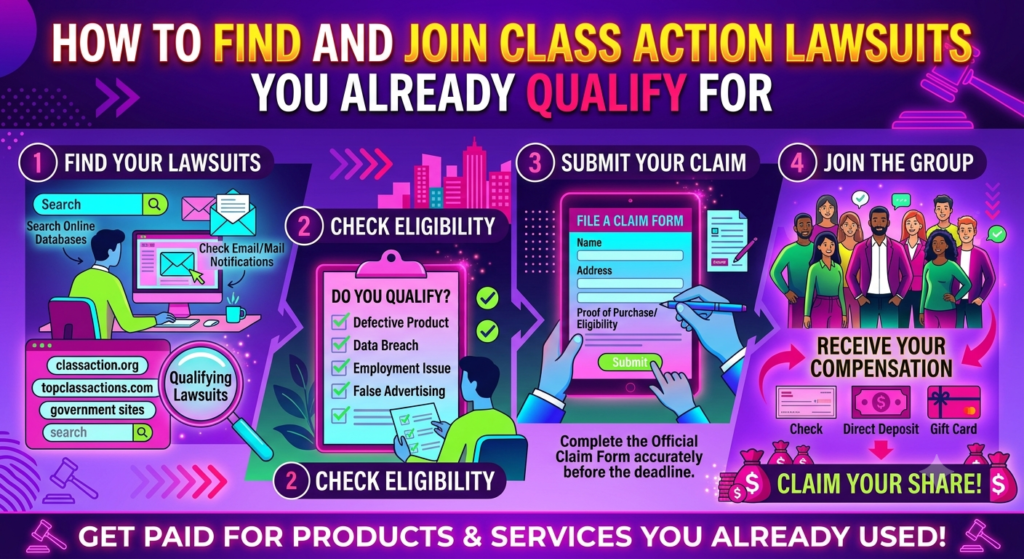
In the modern consumer marketplace, everyday citizens are constantly exposed to corporate misconduct, systemic data privacy failures, deceptive marketing practices, and manufacturing defects. Whether it is a multinational technology conglomerate secretly leaking your private biometric data, an automotive manufacturer distributing vehicles with fundamentally flawed braking systems, or a pharmaceutical brand misrepresenting the safety profiles of over-the-counter medications, individual consumers routinely bear the financial and emotional brunt of corporate negligence. When an individual loses $50 or $100 due to corporate deception, filing an independent civil lawsuit is economically impossible, as corporate billable hours and court filing fees will instantly eclipse the potential recovery amount.
This structural legal imbalance is exactly why the American judicial system utilizes the power of the **class action lawsuit**. Governed by rigorous procedural frameworks, a class action aggregates thousands—sometimes millions—of independently minor consumer claims into a single, high-stakes institutional lawsuit. This consolidation levels the playing field, allowing everyday citizens to square off against Fortune 500 legal teams and secure multi-million-dollar financial restitutions. However, a massive operational gap remains: every year, billions of dollars in court-mandated settlement funds sit entirely unclaimed in federal repositories simply because eligible consumers do not know they qualify or are completely unaware of how to join a class action lawsuit. This definitive, deep-dive guide serves as your ultimate strategic blueprint to navigate the class action ecosystem, locate settlements you already qualify for, and claim your rightful share of corporate restitution.
The Legal Engine: How Class Action Settlements Are Built
To successfully navigate and claim funds from these large-scale legal actions, a consumer must understand the foundational legal mechanics that govern them. Class actions do not materialize out of thin air; they are the product of a highly regulated sequence within the United States federal or state court systems under Rule 23 of the Federal Rules of Civil Procedure:
The Certification Phase
Before a case can proceed as a class action, a judge must formally “certify” the class. This requires the plaintiff’s legal team to definitively prove four core metrics: *Numerosity* (the group of harmed individuals is so large that individual lawsuits are impractical), *Commonality* (there are shared legal and factual issues across the entire group), *Typicality* (the claims of the lead plaintiff are typical of the rest of the group), and *Adequacy* (the lead plaintiff and counsel will fairly protect the interests of the class).
The Settlement Framework
Once certified, rather than risking a volatile and lengthy jury trial, corporations frequently choose to execute a structured settlement. The defendant company establishes a massive, multi-million-dollar cash fund dedicated exclusively to compensating the class members in exchange for a complete release of future liability. A specialized, court-appointed third-party organization known as a **Claims Administrator** is then hired to manage the distribution infrastructure, review consumer claim forms, and issue checks or digital payouts.
Comprehensive Analysis: Open Claims Registry Matrix
To understand the sheer diversity of active consumer litigation fields where you might possess unrecognized eligibility, review the analytical matrix below detailing the primary sectors driving massive consumer payouts:
| Litigation Sector | Primary Harm Metric | Typical Qualifying Criteria | Common Proof Requirements |
|---|---|---|---|
| Data Privacy & Breaches | Unlawful distribution of PII (Social Security numbers, credit profiles, passwords). | Owning an active account with the breached entity during the specific compromise window. | None (verified via account email or unique claimant ID sent by the administrator). |
| Deceptive Consumer Marketing | False advertising claims (e.g., calling a product “100% organic” when it contains synthetic chemicals). | Purchasing the specific consumer good within a multi-year retail timeframe. | Often waived for claims under $25; store receipts or loyalty card data for larger amounts. |
| Automotive Structural Defects | Defective components (airbags, engines, transmissions) causing depreciation or safety hazards. | Leasing or purchasing a specific model year vehicle within the designated VIN registry. | Vehicle Identification Number (VIN), repair shop invoices, or dealership service records. |
| Antitrust & Price Fixing | Corporate cartels artificially inflating baseline costs of goods (electronics, tuna, airline tickets). | Purchasing specified components or services during the anti-competitive window. | Receipts, corporate purchase orders, or wholesale account statements. |
Step-by-Step Blueprint: How to Find and Join a Class Action Lawsuit
Unlocking the funds you are legally owed requires transitioning from a passive consumer to an active claimant. Because individual payouts can range from a nominal $20 digital transfer to thousands of dollars for automotive or medical claims, executing this disciplined step-by-step methodology ensures you never miss a valid filing window:
Step 1: Aggregate and Leverage Verified Class Action Aggregators
You do not need to read through hundreds of federal court dockets to find open settlements. Instead, monitor specialized, highly reputable clearinghouses that track consumer litigation in real time. Platforms such as *TopClassActions.com*, *ClassAction.org*, and the open consumer portals hosted by the Federal Trade Commission (FTC) maintain fully searchable databases of active settlements. You can filter these registries by brands you interact with, products you have purchased, or digital services you routinely utilize.
Step 2: Understand the Crucial Distinction: Opt-In vs. Opt-Out Mechanics
This is where many consumers become profoundly confused. In the vast majority of U.S. consumer class actions, the legal structure operates on an **Opt-Out framework**. This means that if you meet the structural definition of the certified class (e.g., you owned a specific smartphone between 2021 and 2024), **you are automatically included in the lawsuit by default**. You do not need to hire an attorney or sign up to be part of the litigation. However, to actually receive your cash distribution from the final settlement pool, you *must* take action by filing a formal claim form before the strict court-mandated deadline. If you do nothing, you receive zero compensation, and you legally forfeit your right to ever sue that company individually for that specific issue.
Step 3: Complete the Electronic Claim Form with Absolute Precision
Once you locate an open settlement that matches your consumer history, navigate directly to the official settlement website established by the court-certified Claims Administrator (always ensure the URL is verified and secure to avoid phishing clones). The claim form will require you to input basic identifying data and answer specific qualifying questions. For an analytical parallel on how complex legal claims valuations and structural settlement payouts are formulated across distinct consumer and corporate frameworks, explore our comprehensive guide detailing how insurance claim settlement amounts are calculated.
Navigating the Proof Framework: Claims With vs. Without Proof of Purchase
A primary psychological barrier that stops consumers from filing legitimate claims is the belief that they must possess physical paper receipts from years ago. This is an incorrect assumption that causes billions to go unclaimed. Under modern settlement architectures, claims are systematically divided into two distinct processing tiers:
Tier A: No-Proof-Of-Purchase Claims
Recognizing that everyday citizens do not archive grocery or retail receipts for years, courts routinely approve settlement structures that allow consumers to submit a claim under penalty of perjury without providing documentation. These baseline claims typically cap individual payouts at a set maximum (e.g., $5 per item, up to a maximum of $25 per household). If you legitimately purchased the product, you are legally authorized to sign and file this electronic claim form.
Tier B: Documented Claims (With Proof)
If your consumer history involves significant, repeated purchases of an inflated product, or if the claim involves high-value consumer electronics or automotive repairs, providing concrete proof unlocks the maximum potential payout pool. Documented tiers frequently offer uncapped financial reimbursement for the actual losses sustained. Valid proof configurations include:
- Digital order confirmations, invoices, or e-receipts archived in your email history.
- Credit card or bank statement line items showing transactions with the specific retail merchant.
- Store loyalty program purchase histories (which can be exported directly from apps like Target, Walmart, or Kroger).
If a claims administrator wrongfully rejects your documented claim or denies your eligibility despite clear evidentiary support, you must be prepared to contest the administrative adjustment. Consumers can gain valuable insight into challenging adverse claims determinations by examining our detailed strategic guide on how to appeal an auto insurance claim denial, which highlights the structural methodologies required to overturn bureaucratic pushback.
Advanced Strategies: Spotting Legal Notices and Identifying Phishing Scams
As you become active in recovering your rightful capital through the class action framework, your email and physical mailbox will occasionally receive official legal alerts titled **”Notice of Proposed Class Action Settlement.”** Do not mistake these documents for junk mail or marketing solicitations. These notices contain your unique **Claimant ID** and **PIN**, which bypass the need for proof of purchase and fast-track your approval directly through the administrator’s processing engine.
However, because billions of dollars flow through these distribution networks, cybercriminals occasionally deploy fraudulent, lookalike phishing portals designed to steal your personal data under the guise of an insurance or class action payout. To insulate your digital identity and ensure you are interacting strictly with legitimate, court-authorized legal administrators, always cross-reference the firm’s standing. You can review standard operational frameworks for verifying institutional legitimacy by reading our specialized advisory on how to check an FCA authorised firm in the UK within international financial parameters.
The Ultimate Consumer Class Action Activation Checklist
Before submitting any digital claim form or assessing your eligibility for an open corporate settlement pool, systematically complete this critical operational checklist:
- [ ] Verified the exact matching criteria of the class definition (dates of purchase, specific product models, geographic state restrictions).
- [ ] Confirmed that the digital portal you are utilizing is the official, court-certified settlement domain managed by an accredited Claims Administrator (e.g., Kroll, Epiq, or Angeion Group).
- [ ] Evaluated your personal records (emails, bank statements, loyalty apps) to locate any required proof of purchase to unlock higher payout tiers.
- [ ] Input your information accurately, ensuring your name matches the transaction profiles associated with the compromised account or product purchase.
- [ ] Selected a secure, reliable payment distribution method (Direct Deposit, PayPal, Venmo, or physical check) that remains active through the distribution timeline, which often takes 6 to 12 months post-deadline.
- [ ] Set up an internal alert system to check the status of your claims, mirroring the proactive approach used to learn how to check if you have a compensation claim for unresolved corporate violations.
Conclusion
Billions of dollars are distributed annually through the U.S. judicial system as direct punishment for corporate negligence, and a portion of that capital belongs to you. Learning how to join a class action lawsuit is not about exploiting a legal loophole; it is about actively exercising your legal rights as a consumer and participating in a system designed to enforce market accountability. By regularly auditing active settlement registries, understanding the precise parameters of class definitions, maintaining clean digital transaction histories, and filing accurate claims before court deadlines, you can systematically reclaim hundreds—or even thousands—of dollars in corporate restitution. Do not leave your hard-earned capital sitting unclaimed in administrative escrow pools. Take control of your consumer profile, deploy the frameworks outlined in this guide, and ensure that corporate entities are held financially accountable for the products and services they deliver to your household.
Disclaimer: This comprehensive consumer guide is provided strictly for educational and general informational purposes. Class action legal frameworks, court certification boundaries, claims administration filing windows, and final per-capita payout metrics are fluid, highly volatile, and subject to direct modification by federal and state judicial officers. This content does not constitute formal legal representation or personalized financial advice. For complex legal scenarios or before forfeiting significant individual litigation rights, consumers must consult with a fully licensed attorney specializing in consumer protection law.